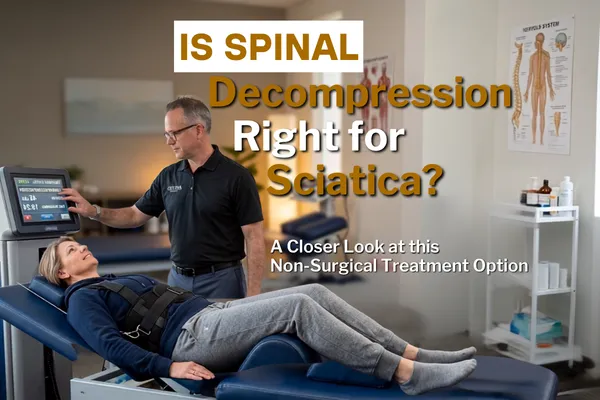
Is Spinal Decompression Right for Sciatica?
Spinal Decompression, Sciatica Treatment, Lower Back Pain Relief
If you’re dealing with burning, shooting pain down your leg, trouble sitting or standing for long, or that deep ache in your lower back, you might be wondering if spinal decompression for sciatica could finally give you some relief. By the end of this article, you’ll understand what non-surgical spinal decompression is, how it fits into sciatica treatment, what it feels like, who it’s best for, and what you can realistically expect if you choose to work with Dr. Thomas Szalay, DC, here in the Youngstown, Poland, and greater Mahoning Valley area.

When Sciatica Starts Controlling Your Day
Sciatica is more than “a bad back.” It’s that sharp, electric pain that can shoot from your lower back or hip down into your leg, sometimes all the way to your foot. For some people, it feels like pins and needles; for others, it’s a deep, throbbing ache that just won’t quit. It can make driving, working, or even sitting at the dinner table in Youngstown or Poland, OH, feel like a chore instead of a normal part of your day.
If you’re reading this, you might already have tried rest, pain pills, or maybe even a round or two of physical therapy. Maybe your doctor mentioned injections or surgery, and that idea doesn’t sit well with you. You’re not alone. Many of the patients who walk into Szalay Chiropractic are looking for a sciatica treatment that is effective, but also non-surgical, gentle, and tailored to their real life, not a textbook case.
What Exactly Is Sciatica, in Plain Language?
Sciatica is a word we use to describe irritation of the sciatic nerve, the large nerve that runs from your lower back, through your hips and glutes, and down each leg. According to the Mayo Clinic, sciatica often happens when something in the lower spine – like a herniated disc, bone spur, or spinal narrowing – puts pressure on that nerve and causes pain, numbness, or weakness along its path.
In everyday terms, that means something in your back is crowding or pinching a nerve that does not like to be crowded or pinched. That’s why you can feel the pain in your leg even though the problem often starts in your spine. So, when we talk about chiropractic care for sciatica, we’re really talking about helping your spine move and line up in a way that takes pressure off that irritated nerve and lets it calm down.
What Is Non-Surgical Spinal Decompression for Sciatica?
Non-surgical spinal decompression is a gentle, computer-guided therapy that uses a specialized table to slowly and safely stretch your spine. The goal is to reduce pressure inside the discs – the soft cushions between your vertebrae – and create a little more breathing room for the nerves that exit your spine, including the sciatic nerve. Unlike traditional traction, modern decompression therapy is carefully controlled and can be adjusted to your comfort level and specific condition on each visit.
The National Center for Biotechnology Information (NCBI) notes that spinal decompression can help reduce pressure in spinal discs, which may support healing and pain relief in certain patients with disc-related lower back pain and sciatica. That doesn’t mean it’s a magic fix, but it does mean there is a reasonable, science-backed explanation for why many people feel better with this type of care.
How Spinal Decompression Supports Herniated Disc Treatment
A common cause of sciatica is a herniated disc – sometimes called a “slipped” or “bulging” disc. In simple terms, the disc has pushed outward just enough to irritate or press on the nearby nerve. With spinal decompression, we use gentle pulling forces to slightly separate the vertebrae. This can lower the pressure inside the disc and, in some cases, encourage that bulging material to retract a bit, taking pressure off the nerve and easing pain in your lower back and leg.
You can think of it like giving your disc a chance to “breathe.” As the pressure drops, more oxygen, water, and nutrients can move into the disc. Over time, this can support the disc’s natural healing process. The Cleveland Clinic explains that many herniated discs can improve without surgery when the pressure on them is reduced and the surrounding tissues are cared for properly. In our office, spinal decompression is one of the tools we use to support that process, alongside chiropractic adjustments, targeted exercises, and lifestyle guidance.
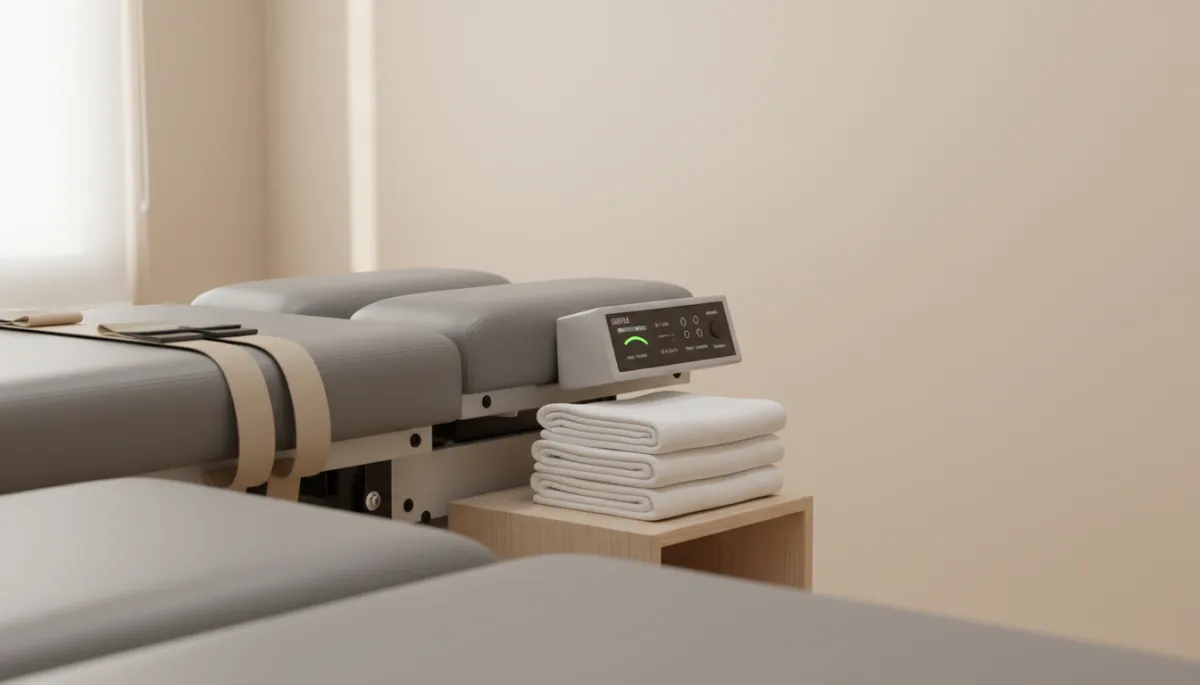
Gentle, computer-guided decompression lets us fine-tune treatment to your comfort and needs.
What Does Spinal Decompression Feel Like?
Most patients are pleasantly surprised by how comfortable non-surgical spinal decompression feels. You’ll lie down on a padded table, either on your back or your stomach, depending on your condition. A harness is gently secured around your hips, and the machine is programmed with your specific settings. As the session begins, you’ll feel a slow, steady pull in your lower back. Many people describe it as a gentle stretch or a feeling of “taking pressure off” the spine, not a yank or a jerk.
A typical session lasts about 15–30 minutes. You can breathe normally, listen to music, or simply relax. Some patients feel immediate lower back pain relief or less tension after a session, while others notice gradual improvement over several visits. If anything feels uncomfortable, we adjust the settings right away. You are always in control, and we move at a pace your body can handle.
⚠️ Important: Spinal decompression should always be supervised by a trained provider. It is not appropriate for everyone, especially if you have certain conditions like spinal fractures, severe osteoporosis, or specific types of spinal instability. That’s why a thorough exam is so important before starting care.
Is Spinal Decompression Right for Your Sciatica?
This is the big question, and the honest answer is: it depends on what’s causing your sciatica and what’s going on in your overall health. Spinal decompression for sciatica tends to be most helpful when your pain is related to:
A herniated or bulging disc in the lower back
Degenerative disc disease with nerve irritation
Spinal joint compression that’s crowding the nerve roots
During your first visit at Szalay Chiropractic, we don’t just look at your pain; we look at you. Dr. Szalay will review your history, ask about your work, hobbies, and daily activities, and perform a hands-on exam. If you’ve had imaging like an X-ray or MRI, we’ll go through it with you in plain language. From there, we can determine whether non-surgical spinal decompression is a good fit or if another sciatica treatment approach would serve you better.
How Spinal Decompression Fits into a Complete Sciatica Treatment Plan?
One of the biggest misconceptions is that spinal decompression alone will “fix” everything. In reality, lasting lower back pain relief usually comes from a combination of treatments and lifestyle changes that work together. At Szalay Chiropractic, decompression is often part of a broader chiropractic care for sciatica plan that may include:
Gentle chiropractic adjustments to improve spinal alignment and motion
Targeted exercises and stretches to strengthen and support your core and hips
Posture and movement coaching, especially for work, driving, and sleep positions
Home care strategies like heat, ice, or simple mobility routines
The goal is not just to calm your sciatic nerve today, but to help your spine and supporting muscles work better so the problem is less likely to flare up again. We want you to feel confident walking around Mill Creek Park, getting through a shift at work, or sitting through a grandchild’s game without constantly thinking, “How long until my leg starts burning?”
What Kind of Results Can You Realistically Expect?
Everyone’s body, history, and lifestyle are different, so no responsible provider can guarantee a specific outcome. That said, many patients do report less pain, better mobility, and an easier time with daily activities after a series of decompression sessions combined with chiropractic care and home exercises. Some feel changes within a few visits; others notice a slower, steady improvement over several weeks as inflammation calms and the spine becomes more stable.
A typical plan for non-surgical spinal decompression might include multiple visits per week at first, then gradually tapering as your symptoms improve and your spine responds. Throughout the process, we check in with you, track your progress, and adjust your plan if something isn’t working as well as we’d like. You’re never “locked in” to a one-size-fits-all protocol; your body and your goals lead the way.
Who May Not Be a Good Candidate for Spinal Decompression?
As helpful as spinal decompression can be for some people, it’s not right for everyone. You may not be a candidate if you have:
Recent spinal fractures or spinal surgery that has not fully healed
Severe osteoporosis or bone weakness that makes your spine fragile
Certain spinal tumors, infections, or advanced instability
Pregnancy, depending on the stage and your comfort
This is why that first, detailed evaluation is so important. Our job is not to fit you into a specific treatment, but to match the right treatment to you. If spinal decompression isn’t appropriate, we’ll talk through other options for sciatica treatment and lower back pain relief that still honor your wish to avoid unnecessary medications or surgery whenever possible.
What to Expect at Your First Visit with Dr. Szalay
Walking into a new office when you’re in pain can feel intimidating. Our goal is to make that first visit feel like a conversation, not an interrogation. We’ll start by listening – really listening – to your story: when your sciatica began, what makes it worse or better, what you’ve already tried, and what you’re most worried about. Many patients tell us no one has ever taken the time to connect all those dots before, and that alone can be a relief.
Then we’ll perform a focused exam, checking your posture, range of motion, reflexes, and specific nerve and muscle tests. If we suspect a herniated disc or another structural issue, we may review existing imaging or, if needed, recommend appropriate imaging through your medical provider. Once we have a clear picture, we’ll sit down with you and explain – in plain language – what we found, what it means, and how spinal decompression, chiropractic adjustments, and other care options might fit into your plan.
Questions Patients Ask About Is Spinal Decompression Right for Your Sciatica?
Does spinal decompression really help sciatica, or is it just hype?
Non-surgical spinal decompression can be genuinely helpful for many people whose sciatica is caused by disc problems or nerve compression in the lower back. By gently reducing pressure inside the discs and creating more space for the nerves, it may ease pain and improve mobility over time. It’s not a miracle cure, and it doesn’t work the same for everyone, but for the right patient, it can be a powerful part of a complete sciatica treatment plan. The key is a proper evaluation to see whether your specific condition is a good match.
How many spinal decompression sessions will I need for sciatica relief?
The number of sessions depends on how long you’ve had symptoms, what’s causing your sciatica, and how your body responds. Many treatment plans start with several visits per week for a few weeks, then taper down as your pain decreases and your function improves. Some patients notice changes within a handful of visits, while others need a longer series to see consistent results. At Szalay Chiropractic, we’ll outline a clear plan up front and adjust it based on your progress and feedback.
Is spinal decompression safe for older adults with lower back pain?
Spinal decompression can be safe for many older adults, especially when it’s customized and closely monitored. However, conditions like severe osteoporosis, spinal fractures, or certain types of arthritis may make decompression inappropriate or require extra caution. That’s why we always perform a thorough exam, review your medical history, and, when necessary, coordinate with your other healthcare providers before recommending this therapy. Our goal is to help you feel better without putting your spine at risk.
Will spinal decompression replace the need for sciatica surgery?
For some patients, non-surgical spinal decompression, combined with chiropractic care and lifestyle changes, can reduce pain enough that surgery is no longer necessary or can be delayed. For others with severe nerve damage, loss of bowel or bladder control, or certain structural issues, surgery may still be the safest option. We never promise that decompression will “avoid surgery” in every case, but we do see it help many people feel and function better without going straight to the operating room. If your case is more complex, we’ll discuss that openly and help you weigh your options.
Does spinal decompression hurt, or will it make my sciatica worse?
Most patients find spinal decompression to be comfortable, and many describe it as a gentle stretch or feeling of pressure being relieved. It is normal to feel some mild soreness or fatigue in the area after early sessions, similar to how you might feel after starting a new exercise. However, it should not feel sharp, burning, or alarming. If anything feels off, we stop, reassess, and adjust your settings so we are always working within your comfort and safety zone.
Is spinal decompression covered by insurance for sciatica treatment?
Insurance coverage for spinal decompression varies by plan and provider. Some policies may cover portions of your sciatica treatment, such as chiropractic evaluations and certain therapies, while others may consider decompression an out-of-pocket service. Our team can help you review your benefits and understand what’s covered before you commit to a treatment plan. We’ll always talk through costs and options so there are no surprises.
A Realistic, Hopeful Path to Lower Back Pain Relief
Living with sciatica can make you feel stuck – stuck on the couch, stuck saying no to plans, stuck wondering if this is just how life has to be now. Spinal decompression for sciatica isn’t about pretending your pain isn’t real or promising a quick fix. It’s about giving your spine and nerves a better environment to heal, using gentle, non-surgical tools that respect your body and your goals. Combined with thoughtful chiropractic care for sciatica, movement coaching, and home strategies, it can be a powerful step toward feeling more like yourself again.
If you’re in Youngstown, Poland, or anywhere in the Mahoning Valley and wondering, “Is spinal decompression right for my sciatica?”, the next best step is a thorough, honest evaluation. From there, we can talk through whether non-surgical spinal decompression, herniated disc treatment, or another approach makes the most sense for your situation – with no pressure and no scare tactics, just real information and a plan that fits your life.
Medical Disclaimer: The information in this article is for educational and informational purposes only. It is not a substitute for professional medical advice, diagnosis, or treatment. Always consult Dr. Thomas Szalay, DC, or another qualified healthcare provider with any questions you have about your specific condition or before starting any new treatment.
If you’re ready to find out whether spinal decompression is a good fit for your sciatica, you can schedule a new patient appointment with Szalay Chiropractic online. We’ll sit down together, look at the full picture, and build a plan to help you move, sit, and sleep with more comfort again. Book your visit here.
